Showing posts with label wind power. Show all posts

Monday, July 28, 2014

Renewables Are "Winning" A Rigged Race

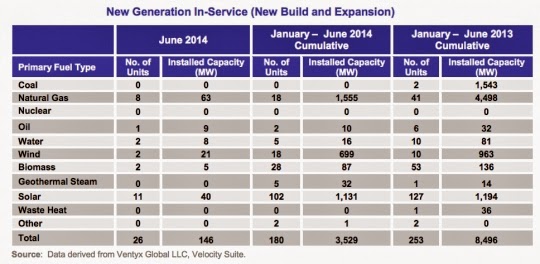
"Green energy" panacea-pushers at The Energy Collective (at least the name clues one in to their collectivist leanings) are hyperventilating again over the seemingly large percentage of new U.S. energy capacity being added by so-called renewables, which mostly means wind and solar. Here's the situation in one handy-dandy chart.


But these gains are only impressive when taken out of context.

Renewables only appear to be gaining so much ground because two of their primary (and most potent) energy sector rivals, coal and nuclear power, are effectively dead in the water, thanks to the unfavorable (nay, hostile) political and regulatory climate created by the Obama White House and its Big Green allies. Note the long string of zeros to the right of coal and nuclear power. Renewables are "winning" the Daytona 500 because their rivals are stuck in the pits.  

The long-rumored U.S. nuclear energy revival is nowhere in sight, despite President Obama's "all-of-the-above" campaign rhetoric. And while the shale gas revolution can't be ignored as a contributing factor, knee-jerk opposition from extremists, and the daunting regulatory climate such resistance creates, very likely trumps market conditions as a primary cause. And building new coal-fired power plants isn't any easier, given a wave of EPA carbon mandates (backed up my court rulings) that seem designed to outlaw America's most abundant domestic energy source. Add in all the direct and indirect support and subsidies renewables receive, including mandates that guarantee them a market share, and it's not easy to see why these niche energy technologies appear to be on such a roll.

Force them to compete in an honest and free energy market, in which politicians aren't rigging the game in favor of politically-popular "pets," and the new capacity added by wind and solar would be what it's been for decades -- relatively insignificant, in the grand scheme of things. All these trend lines show is that America's foolish rush down the "green energy" rabbit hole is accelerating, as it abandons tried-and-true for pie-in-the- sky.      

Nor does this gloating by "green energy" proponents take into account the quality of the energy being added, though that matters a great deal because not every megawatt is created equal. What counts most in this modern industrial society, which requires and expects on-demand energy, is dispatchability -- the ability of a generating entity to increase or decrease power (at the flip of a switch, ideally, or faster) in response to the ebbs and flows of demand on the grid. This kind of power, sometimes called "base load" or "peaking power," just isn't something intermittent energy generators like wind and solar can dependably provide, making them of marginal utility in the grand scheme of things.

Mild concerns about grid stability and reliability, in light of the looming carbon mandates, have recently been voiced by some members of the Federal Energy Regulatory Commission, which thankfully isn't chaired by shot-down Colorado nominee Ron Binz. But such worries are predictably pooh-poohed by Democrats on the board, who would rather risk rolling brownouts than inject a little realism into the debate. They might look to Germany as a case study in what can happen, in terms of grid instability, when you stumble dangerously far down this particular path.      

One day, perhaps, the grid won't function as it does today. One day, perhaps, we'll have the ability to store-up intermittent energy and dispatch it on-demand, addressing this deficiency. But until that someday arrives we're stuck with the reality of the grid as it works now, which limits renewables to a niche roll. Simply touting added capacity, without also examining what kind of capacity is being added, seems like just another effort to lead energy illiterates down the primrose path.     

Saturday, June 18, 2011

Keep Pulling the Plug, Doug

It's a shame that U.S. Rep. Doug Lamborn is backpedaling on his support for federal funding cuts that could have led to staff reductions at the National Renewable Energy Lab in Golden, Colorado. He's obviously caving-in to political pressure from others in the Colorado congressional delegation, who like to crow about all the techno-wizardry the lab supposedly cranks out but really only care about the federal revenues and jobs it keeps in state.

Lamborn was right the first time on NREL, even if he was right by mistake. It's time to pull the plug on the lab. It lab has been sucking on the taxpayer teat since 1974, with precious little to show for it in terms of renewable energy breakthroughs, and all it's really good for is keeping a lot of federal technocrats employed in Colorado. NREL has been studying solar and wind power breakthroughs since I was in junior high school, yet neither technology even today can compete with conventional energy sources -- which is why solar and wind must rely on taxpayer subsidies and government mandates to increase their meager market share.

NREL has failed, in other words, if one looks objectively at the results. If what the lab produces is so damn valuable, it ought to be able to support itself on the royalties it receives from technology transfer deals with private companies. But the lab received only $1 million in royalty returns last year, reports the Denver Post, while "investing" $350 million of your tax dollars in research. That's not just a lousy return on investment, it's corporate welfare of the worst kind.

Wind and solar power were held-up as our energy portfolio saviors way back in the mid-1970s, two or three energy crises ago, yet the same windy and sunny promises are being repeated 35 years later -- showing how little real progress the wizards inside NREL have made. Doug's original push to pull the plug on NREL was completely justified, even he's backing away now and calling it a mistake.

Monday, January 26, 2009

Wind farm decision weighs heavy on Obama's shoulders

Joe Biden said Barack Obama would be tested early in his administration, and now that prediction seems eerily prescient. Someone must decide whether to approve a wind farm off Cape Cod that could ruin Teddy Kennedy's views. And because this is America -- where every stupid decision becomes a federal case -- this is naturally something that lands on the desk of the man at the top.

No one said this president thing was going to be easy, Mr. Obama. This is why you get to fly around in a really big jet and have a Saturday radio address.

Next up on Obama's must-decide list: Whether or not to move ahead with a new Jiffy-Lube in Kalamazoo.

Thursday, June 5, 2008

Enron’s other scam: going “green”

Some may wonder why certain large U.S. corporations, bucking expectations, seem almost welcoming about the tidal wave of “greenhouse gas”-related regulations bearing down on them. But it’s not necessarily motivated by altruism, high-mindedness or some pangs of corporate guilt about leaving large carbon footprints behind. Some may simply be bowing to reality and inevitability, hoping that jumping aboard the bandwagon early (in addition to being good PR) will prompt the politicians and regulators to go easy on them. Others see an angle, and an opportunity to be exploited, in it.

One CEO who early-on saw the profit-making potential in playing the green game was Enron’s Ken Lay, as this eye-opening column in the Houston Chronicle recounts:
http://www.chron.com/disp/story.mpl/business/steffy/5817644.html. “Under Lay, Enron championed a host of government-supported "green" energy initiatives, all designed to help its businesses, from natural gas to electricity trading to wind farms,” Loren Steffy writes, quoting a former Lay aide who says he wasn’t quite the free-marketer he seemed. Rather than fight government regulation and intervention, Lay the game-player embraced it, angling for ways to cash-in. Half-hearted energy deregulation meant huge profits for Enron, while imposing a lot of pain on energy consumers.

But the fall of Enron didn’t end the story (perhaps because this part of the Enron scam has been ignored or glossed over): on the contrary, the gaming of the political and regulatory system by supposedly “green” companies goes on -- and on an even grander scale than in Lay's day. A whole new “parasite industry” has been born, as the column suggests, thanks to the mania for "renewables" and biofuels. And it will only grow when Congress gets done with its climate change work.

Ken Lay’s Enron today stands as a symbol of political string-pulling, cynical market manipulation and unbridled greed. But most of the finger-waggers tell only part of the story. Perhaps, in the not-too-distant future, the same condemnation will be heaped on the spate of “parasitic industries” that are following in Lay’s footsteps and cashing-in by going "green."